Stay Longer, Spend Less: The Legal Playbook Budget Travelers Use to Stretch Their Time Abroad
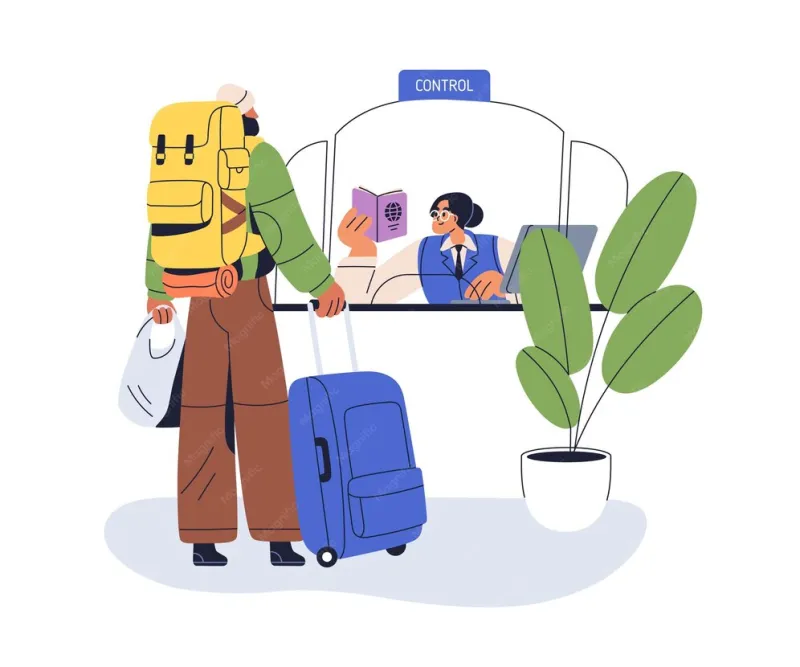
Photo: backpacker crossing border checkpoint with passport and travel bag, via img.freepik.com
You're sitting in a hostel common room in Chiang Mai, three weeks into what was supposed to be a two-month trip, and someone at the ping-pong table casually mentions they've been in Southeast Asia for eight months. Eight months. On a tourist visa. Legally.
Your first instinct might be skepticism. Your second should be curiosity. Because the truth is, a growing number of budget travelers have figured out how to work within the system—not around it—to dramatically extend their time abroad. No shady workarounds, no overstay risks, just strategy.
This is the playbook.
Understanding What You're Actually Working With
Before anything else, you need to know the rules of the game. Most US passport holders get 30 to 90 days on arrival in a huge chunk of the world's most backpacker-friendly countries. Thailand offers 30 days visa-free with the option to extend once for another 30 days in-country. Indonesia gives you 30 days. Vietnam recently bumped its visa-free window to 45 days for Americans. Portugal, as part of the Schengen Zone, allows 90 days within any 180-day period across 27 countries.
The key insight most first-timers miss: these windows are starting points, not ceilings.
"I didn't realize until my second trip that the 90-day Schengen rule resets based on a rolling window, not a calendar year," says Marcus, a 28-year-old from Denver who's been slow-traveling Europe for the past year. "Once I understood the math, I could plan a whole circuit that kept me in Schengen countries for 90 days, then dip into the Balkans for a few months, then re-enter. Perfectly legal, way cheaper than flying home."
The Classic Border Run—And When It Actually Makes Sense
The term "visa run" gets thrown around loosely, but the legitimate version is pretty straightforward: you exit a country before your visa or visa-exempt period expires, cross into a neighboring country, and re-enter to reset your stay.
In Southeast Asia, this is practically a rite of passage. The Thailand-to-Malaysia land crossing at Padang Besar or the Thailand-to-Laos crossing at Nong Khai are well-worn routes. Budget: as low as $20–$40 round trip by bus or train, depending on the route. Time: a single day in many cases.
But here's the nuance nobody puts in the travel blogs: immigration officers notice patterns. If you're crossing the same border every 30 days for six months, you may start getting questions—or denied entry. Thailand in particular has tightened scrutiny on what officials call "visa run tourists." The legal workaround? Actually go somewhere on your run. Spend a few days in Penang or Vientiane. Eat the food, stay in a hostel, let the trip breathe.
Jordan, a 31-year-old from Austin who spent nine months in Southeast Asia on a shoestring, puts it bluntly: "If your visa run looks like a real trip—and it is one—nobody bats an eye. I ended up loving some of those 'obligation' stops more than places I'd planned for months."
Slow Travel as the Ultimate Visa Hack
Here's the strategy that costs you nothing and gives you everything: slow down.
Slow travel isn't just a lifestyle aesthetic—it's a visa management tool. Instead of burning through a country in a week and flying somewhere new, you stay in one place for two to three weeks, then move to a neighboring country with its own fresh visa window. Rinse, repeat.
Consider this rough timeline for a Central America circuit from a US hub:
- Guatemala: 90 days visa-free (CA-4 agreement covers Guatemala, Honduras, El Salvador, and Nicaragua as a combined 90-day window—important caveat)
- Belize: not part of CA-4, separate 30-day entry, extendable in-country for a small fee
- Mexico: 180 days visa-free for US citizens
- Panama: not part of CA-4, 90 days visa-free
A traveler who understands these distinctions can build a legitimate 12-month Central America loop without a single flight home.
In-Country Extensions: The Underused Option
Visa extensions within a country are legal, relatively cheap, and wildly underutilized by American backpackers who assume their only option is to leave.
Thailand lets you extend your 30-day stamp for another 30 days at any immigration office for about 1,900 baht (roughly $55). Indonesia offers a 30-day social visa extendable up to 60 additional days through a local sponsor or visa agent—total cost usually under $100. Costa Rica allows extensions through the immigration office in San José.
The catch: you usually need to do this before your current stamp expires. Don't wait until day 29. Go at day 20, give yourself buffer, and avoid the overstay fines that can get you banned from re-entry.
Digital Nomad Visas: The Long Game
For travelers who work remotely—even part-time—digital nomad visas have quietly become one of the best long-term legal options on the market. Portugal's D8 visa, Costa Rica's Rentista visa, and Thailand's new Long-Term Resident (LTR) visa all offer stays of one year or more for qualifying applicants.
Income requirements vary, but many are more achievable than you'd think. Portugal's D8 requires proof of roughly $1,200/month in remote income. For a backpacker already spending $40–$60/day, that's not an unreachable bar.
"I applied for Portugal's digital nomad visa from a hostel in Lisbon," says Priya, a 26-year-old UX designer from Chicago. "The whole process took about six weeks. I just kept slow-traveling through Spain and Morocco while I waited. Now I have a year. It changed everything."
The Budget Reality Check
None of this costs as much as you'd think. A strategic border run: $30–$60. An in-country extension: $40–$80. A slow-travel month in a hostel dorm in Medellín or Tbilisi: $400–$700 all-in, sometimes less. Compare that to a round-trip flight home from Southeast Asia ($600–$1,200) and the math becomes obvious.
The travelers who stay longest aren't necessarily the ones with the most money. They're the ones who did their homework before they left.
Start with your destination country's official immigration website or the US Embassy's country-specific travel pages. Cross-reference with communities like r/solotravel or hostel common rooms full of people who've already run the same gauntlet. And always—always—keep copies of your onward travel plans. Immigration officers like to see that you have them.
The world is more accessible than the visa fine print makes it look. You just have to learn to read between the lines.