Bunks Over Bellhops: The Science Behind Why Hostel Travelers Feel More Alive
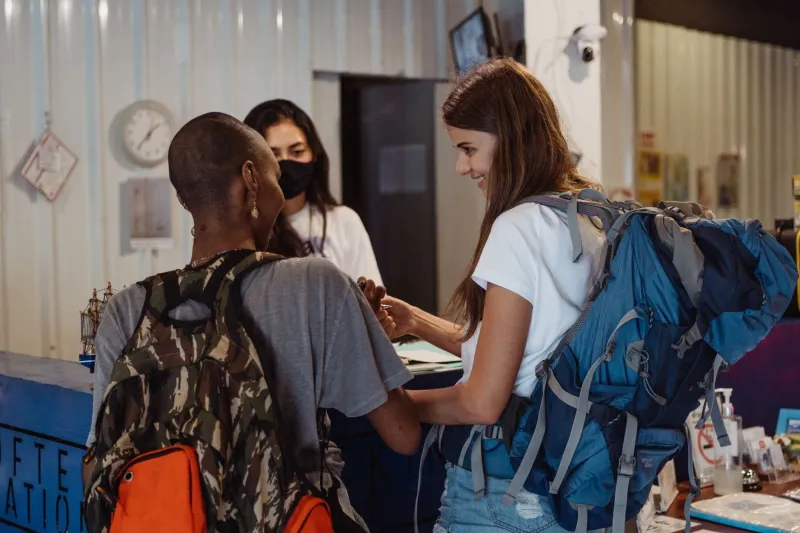
Imagine two travelers. One checks into a boutique hotel in Lisbon — marble bathroom, blackout curtains, room service delivered with a silver cloche. The other tosses a backpack onto a bunk in a shared dorm, introduces herself to three strangers, and ends up sharing a bottle of wine on the rooftop until 2 a.m. By almost every measurable psychological standard, the second traveler is going to go home happier.
That's not just a vibe. There's actual science behind it.
What Researchers Are Finding About Travel and Fulfillment
Positive psychology has spent decades trying to figure out what makes people feel genuinely satisfied with their lives — not just comfortable, but fulfilled. And the findings keep pointing toward the same core ingredients: meaningful social connection, a sense of shared experience, mild doses of productive discomfort, and stories worth telling.
Hostels, almost accidentally, deliver all four.
A body of research on what psychologists call "social baseline theory" suggests that humans are wired to feel safer, more capable, and more emotionally regulated when they're around other people they trust — or are in the process of trusting. Luxury hotel rooms, by design, do the opposite. They isolate. They insulate. They turn travel into a premium version of staying home.
Dr. Elizabeth Dunn, a happiness researcher at the University of British Columbia whose work on spending and wellbeing has been widely cited, has consistently found that spending money on experiences shared with others produces more lasting satisfaction than spending money on comfort or status. A hostel stay is almost a textbook example of that principle in action.
The "Social Currency" of Shared Chaos
There's a concept in social psychology called "misattribution of arousal" — the idea that when people go through something mildly stressful or exciting together, they tend to bond faster and more deeply than they would in neutral conditions. Think about how quickly you become friends with someone after you both miss a train, navigate a confusing bus system, or share a bathroom with six other people and somehow all manage to get out the door in time.
Hostel life is basically a controlled experiment in that phenomenon, running 24 hours a day.
Jake, a 29-year-old from Austin who spent three months backpacking through Southeast Asia, put it plainly: "I stayed in one 'nice' hotel the whole trip — a splurge in Bangkok for my birthday. It was fine. But I was alone in this huge room watching Netflix, and I felt like I could've been anywhere. The hostel nights were the ones I actually remember."
That sentiment comes up again and again among long-term hostel travelers. The stories don't come from the rooms with the best thread counts. They come from the dorms, the common areas, the shared kitchens where someone's always cooking too much pasta and offering to share.
Authenticity as a Psychological Need
Psychologists who study self-determination theory argue that humans have three core psychological needs: autonomy, competence, and relatedness — the feeling of genuine connection to others. Luxury travel tends to satisfy autonomy (you can do whatever you want, whenever you want) but often undercuts relatedness. You're surrounded by staff whose job is to anticipate your needs, not fellow humans navigating the same uncertain adventure.
Hostels flip that equation. You're figuring things out alongside people who are equally lost, equally excited, and equally open to connection in ways that people rarely are at home. There's no social script. Nobody's performing a role. That authenticity, researchers suggest, is deeply nourishing in a way that comfort simply isn't.
Mia, a 34-year-old from Chicago who has traveled extensively across Europe and South America, made a deliberate choice to stay in hostels even after her income grew enough to afford hotels. "I tried upgrading for a trip to Colombia," she said. "It was beautiful, but I came home feeling like I'd watched a travel documentary about myself. Hostels make you an actual participant in the trip."
The "Effort Justification" Effect — And Why Saving Money Feels Good
Here's one more piece of the psychological puzzle: effort justification. Research consistently shows that when people work for something — or sacrifice something — they value the outcome more. Choosing a budget option, navigating a hostel booking, lugging your bag up four flights of stairs because there's no elevator — these micro-challenges actually increase how meaningful the experience feels.
This isn't just rationalization. It's a documented cognitive pattern. And it has a practical upside for budget travelers: the money you don't spend on accommodation becomes fuel for the experiences that actually matter. A street food tour. A cooking class. A spontaneous overnight bus to a city you'd never planned to visit because someone in your dorm mentioned it at breakfast.
That's the real math of hostel travel, and it's not just financial.
What Luxury Can't Buy (But Keeps Trying To)
The hotel industry has noticed. "Social spaces," "curated communal experiences," and "lobby culture" have become major buzzwords in upscale hospitality design over the past decade. Hotels are spending millions trying to recreate something that hostels stumbled into organically: the feeling of being part of something.
But you can't really engineer serendipity. You can't design a lobby that makes strangers feel like they're in it together. That requires a particular kind of openness — the kind that tends to show up when people are traveling light, sleeping in bunks, and not particularly worried about whether the person next to them notices their shoes.
The Takeaway (That Isn't Really About Money)
The case for hostel travel has always been framed around budget. Sleep cheap, the logic goes, and you'll have more left over for the actual trip. That's true, and it matters. But the deeper argument — the one the research keeps making — is that hostel stays aren't just a compromise. For a lot of travelers, they're the whole point.
The friendships that outlast the trip. The stories that actually get told at dinner parties back home. The particular satisfaction of having figured something out in a foreign place alongside a stranger who, by the end of the week, didn't feel like a stranger at all.
No turndown service delivers that. No room service ever will.
If you're still on the fence about your next booking, consider this: the science is pretty solidly on the side of the bunk bed. Your future self — the one with better stories and a fuller address book — will probably thank you.